You carry out the EICR
Inspect as normal and file the result against the property using your TESC contractor account.

After you carry out an inspection, your client can be directed to TESC to view the filed report, see the property’s live electrical safety status and follow the audit trail. If the EICR is unsatisfactory, the compliance issue stays visible — with your company still the obvious route back to a satisfactory outcome.
After inspection, direct the client to TESC to view the filed report and property safety record — not just a PDF buried in an inbox.
Unsatisfactory results, advisories and later satisfactory outcomes form a visible history against the property.
Where a 28-day remedial window applies, the client sees the deadline and is urged to acknowledge and act on it.
Landlords and letting agents can find TESC-registered EICR providers when they need an inspection.
The value is not simply that you can store an EICR. It is that the client can be directed to a third-party record showing exactly what has been filed, what the current electrical safety position is and what still needs to happen.
Inspect as normal and file the result against the property using your TESC contractor account.
Direct the landlord, agent or property manager to their TESC record to view the filed report and current status.
An unsatisfactory outcome remains visible with the remedial deadline and acknowledgement prompt where applicable.
The client is reminded to resolve the defects with their electrical contractor to avoid government fines, while TESC provides the independent compliance message.
Once you have completed the inspection, the client can be directed to TESC rather than left with nothing more than an attachment. Their property page becomes the place they can return to for the filed report, current status and later updates.
Your report is no longer a one-off document the client opens once. TESC keeps the outcome visible and gives the client a reason to come back to the record — and to the contractor who can resolve it.

An unsatisfactory result creates a much stronger customer experience. The TESC record makes the outstanding compliance position visible and, where the legal 28-day remedial window applies, clearly shows when that period ends.
The customer is urged to acknowledge the notice and arrange the required remedial work. TESC reminds them that the legal deadline is 28 days from a failed EICR to avoid government fines of up to £40,000.
You do not need every follow-up to sound like “the electrician wants more work”. The client can see for themselves that the unsatisfactory status is still live, the deadline is approaching and action is required.
For a letting agent or portfolio landlord, the attraction is obvious: they can keep their properties together, see which EICRs are satisfactory, which have advisories, which are unsatisfactory and which remedial cases have been completed.
That is also why more letting agents are choosing TESC-registered EICR providers. If the contractor files into the same system the agent already uses to oversee compliance, the inspection becomes easier for the agent to manage from day one.
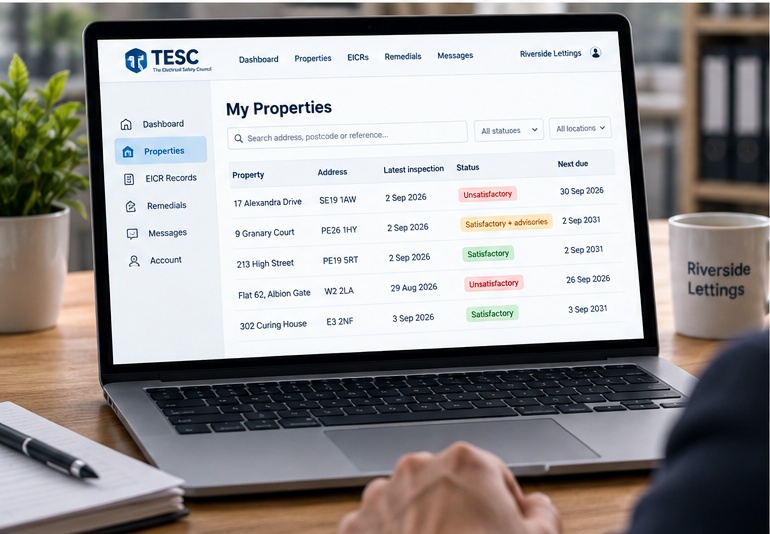
Landlords, letting agents and property owners can use the public provider search when they need an EICR. Registered contractors can appear in those results, giving prospects a route to verify the company and click through to the contractor directly.
For agents already using TESC to manage their property records, choosing a TESC-registered provider makes practical sense: the contractor can inspect, file and keep the same compliance record up to date.
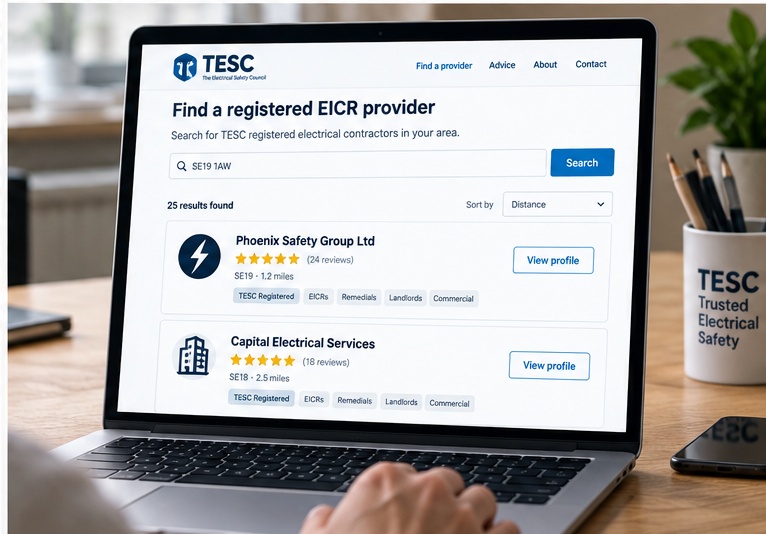
TESC gives clients and letting agents a reason to return to the property record, keeps unsatisfactory outcomes visible until they are resolved and gives registered contractors another route to be found for future EICR work.